Monday, July 31, 2017

LIST OF CRITICAL PARAMETERS DURING GRANULATION


LIST OF CRITICAL PARAMETERS DURING GRANULATION
During the process of granulation in tablet manufacturing a number of parameters to be considered here some of them listed
   1.      Cleaning of area prior to granulation
   2.      Maintain environmental conditions
   3.      Absence of foreign particles
   4.      Types of binder
   5.      Types of binding (impeller & chopper speed and timing)
   6.      Temperature of drying
   7.      Time of drying
   8.      Loss on drying
   9.      Final granule size
   10.  % compressibility
   11.  Flow of powder
   12.  Ratio of granules
   13.  Lubricants used
   14.  Timing of mixing and lubrication
   15.  Storage conditions of RFC powder.

TYPES OF TABLET TOOLING

Definition of Tablets
Tablets can be defined as Solid Pharmaceutical Dosage form containing drug substances with or without suitable diluent and prepare either by compression or moulding methods.
Tablet Tooling
For this purpose different types of punches are used:
Flat- faced bevel- edged.
Shallow concave (Round/ Capsule shaped)
Standard concave (Round/ Capsule shaped)
Deep concave (Round/ Capsule shaped)
Extra deep.
Modified ball
The basic mechanical unit in all tablet-compression equipment includes a lower punch which fits into a die from the bottom and an upper punch, having a head of the same shape and dimensions, which enters the die cavity from the top after tablet material fills the die cavity.
PROCUREMENT OF TOOLING
While ordering any punch set (From Approved Supplier only), following things should be covered:
  1. Drawing for upper/lower punch / die, by the manufacturer as per the specifications given or as per sample punch set.
  2. Following details should be given with the purchase order:
         Total number of set required
         Type of punch set eg. D/B/BB etc.
         MOC to be used (HCHC/OHNS)
HCHC: High Carbon High Chromium
OHNS: Oil Hardened non shrinking Steel
• Engraving details; Sr. no., Mfr name, Date of Mfg., Punch size in mm.
         Special requirements like: Concavity, embossing, chrome plating etc.

Tablet Tooling
There are following types of Tooling available: 
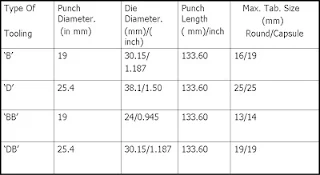
https://topideaofarunrajput.blogspot.in/2017/07/types-of-tablet-tooling.html
TYPES OF TOOLING
‘B’   -Tooling
‘D’   - Tooling
‘BB’ -Tooling
'DB’ - Tooling


Tablet Tooling Parts
Following definitions for direct terminology for tooling (Punches and dies).
1. Head: The end of the punch that guides it through the cam track of tablet machine during rotation.
2. Head flat (Dwell Flat): The flat area of the head that receives the compression force from rollers (in upper punches) and determines the weight and ejection height (in lower punches).
3. Outside head Angle: The area gets in touch with the roller prior to head flat, while compression.
4. Inside Head Angle:This is the area, which pulls down the lower punches after ejection and lifts the upper punches after compression.
5. Neck: The relived area between the head and barrel, which provides clearance for the cams.
6. Barrel: This area guides the punch (while going up and down) with reference to turret guides.
7. Stem: The area of the punch opposite the head, beginning at the tip and extending to the point where the full diameter of the barrel begins. If the chamfer is present the barrel usually reaches its full diameter just above the chamfer.
8. Tip: This determines size, shape & profile of the tablet.
9. Tip face: This area of punch is where the tablet is formed. Good surface finish is required here to bet quality tablets.
Working length: This distance between bottom of the cup and the head flat is called as working length which determines weight and thickness of the tablet.
10. Overall length: Distance between top of the cup and the head flat.
11. Key Angle: The relationship of the punch key to the tablet shape. The keys position is influenced by the tablet shape, take-off angle, and turret rotation.
12Domed Heads: Increases the dwell time and hence help to achieve the better tablet hardness.
13. Dwell time: The time punches spends below the pressure roller while rotating in the machine.


WHAT IS TITRATION AND TYPES OF TITRATION


A titration (titrimetry) is a technique where a solution of known concentration is used to determine the concentration of an unknown solution. Typically, the titrant (the know solution) is added from a buret  to a known quantity of the analyte (the unknown solution) until the reaction is complete. Knowing the volume of titrant added allows the determination of the concentration of the unknown. Often, an indicator is used to usually signal the end of the reaction, the endpoint.

Titrations can be classified by the type of reaction. Different types of titration reaction include:
  • Acid-base titrations are based on the neutralization reaction between the analyte and an acidic or basic titrant. These most commonly use a pH indicator, a pH meter, or a conductance meter to determine the endpoint.
  • Redox titrations are based on an oxidation-reduction reaction between the analyte and titrant. These most commonly use a potentiometer or a redox indicator to determine the endpoint. Frequently either the reactants or the titrant have a colour intense enough that an additional indicator is not needed.
  • Complexometric titrations are based on the formation of a complex between the analyte and the titrant. The chelating agent EDTA is very commonly used to titrate metal ions in solution. These titrations generally require specialized indicators that form weaker complexes with the analyte. A common example is Eriochrome Black T for the titration of calcium and magnesium ions.
  • A zeta potential titration characterizes heterogeneous systems, such as colloids. Zeta potential plays role of indicator. One of the purposes is determination of iso-electric point when surface charge becomes 0. This can be achieved by changing pH or adding surfactant. Another purpose is determination of the optimum dose of the chemical for flocculation or stabilization

  • ·         Gas phase titration

          Gas phase titrations are titrations done in the gas phase, specifically as methods for determining         reactive species by reaction with an excess of some other gas, acting as the titrant. In one common gas phase titration, gaseous ozone is titrated with nitrogen oxide according to the reaction
O3 + NO → O2 + NO2.
After the reaction is complete, the remaining titrant and product are quantified (e.g., by FTIR);  this is used to determine the amount of analyte in the original sample.
Gas phase titration has several advantages over simple spectrophotometry. First, the measurement does not depend on path length, because the same path length is used for the measurement of both the excess titrant and the product. Second, the measurement does not depend on a linear change in absorbance as a function of analyte concentration as defined by the Beer Lambard Law, Third, it is useful for samples containing species which interfere at wavelengths typically used for the analyte.


Disintegration test for Enteric coated tablets


Disintegration test for Enteric coated tablets
The Enteric coated tablets are those tablets which bypass the stomach and get metabolize in the intestine. So firstly the disintegration test done with 0.1 M HCL for 2 hours, tablets should not dissolve in it till 2 hours without disc . Then it must dissolve completely in phosphate buffer solution of 6.8 pH in 1 hour with or without disc.
Preparation of 0.1 M HCL-
Add 8.5 ml of concentrated HCL (37.5%) in 100 ml of water in a volumetric flask with continuously stirring and then make up the volume to 1000 ml with water and stir well.
Preparation of Phosphate buffer solution 6.8pH-
1.       Mixed Phosphate Buffer pH 6.8 As Per IP :- 28.80 gm of disodium hydrogen phosphate and 11.45 gm of Potassium dihydrogen phosphate in 1000 ml with water.
2.       Add 6.8 gm KH2PO4 and about 0.94 gm NaOH in 1000mL Water. Adjust the pH of solution by using dilute Orthophosphoric  acid or NaOH.


Friday, July 28, 2017

Walk in for Ind Swift laboratories ltd

Walk in for Ind swift laboratories ltd Chandigarh at 30 July 2017 and 31 July 2017 for both fresher and experienced candidates at multiple vacancies 

Saturday, July 15, 2017

FLUIDIZED BED DRYER (FBD) AND TYPES OF BAGS USED


Fluidized bed dryers, their construction, working, FBD finger bags, finger bag MOC and their features and application in pharmaceutical manufacturing.

Drying in pharmaceutical manufacturing  is the removal of water and other liquid solvents from the granules or other materials by heat and a current of air. Fluidized bed dryer is used to dry the granules in pharmaceuticals using FBD finger bags.
Principle of Fluidized Bed Dryer (FBD):

1. In fluidized bed dryer hot air is passed at high pressure through a perforated bottom of the container containing granules to be dried.
2. The granules are lifted from the bottom and suspended in the stream of air this condition is called fluidized state.
3. The hot air is surrounding every granule and dries them completely. Therefore, the granules dry equally.
Construction:
The dryer is generally made up of stainless steel. A removable bowl is attached at the base of the dryer that is used for loading and unloading of material. The stainless steel bowl has a perforated base of a wire mesh supporting for material that is being dried. A fan is available at the top of the circulating hot air. Fresh air enters; filters and heat exchange are connected serially to heat the air to the required temperature.
Working:
1. The wet granules to be dried are placed in removable bowl. The bowl is pushed into the fluidized bed dryer.
2. Fresh air passes through the pre-filter, which subsequently get heated by passing through a heat exchange.
3. The hot air flows through the bottom of the bowl simultaneously fan is allowed to rotate.
4. The air velocity is increased with time. When the velocity of the air is more than the settling velocity of the granules, the granule remains partially suspended in the air stream.
5. After some time, a point of pressure is reached at which frictional drag on the particles is equal to the force of gravity.
6. The granules rise in the container because of high velocity of air (1.5 to 7.5 meter per minute) and later fall back in a random boiling motion. This condition is said to be fluidized state. The gas surrounds every granule to completely dry them.
7. The air leaves the dryer by passing through the bag filter. The entrained particles remain attached to the inner surface of the finger bags. The bag is shaken periodically to remove the attached particles.
FBD Finger Bag:
Fluidized bed dryer filter bag are made up of different type of superior quality of fabrics, as per requirement of material involving in drying.
Different types of fabrics are:
1. Antistatic
2. Polypropylene
3. Stain
The manufacturing of fluidized bed dryer filter bag depends on required factor like retention micron, static change and air permeability. Fluidized bed dryer filter bags are cost efficient and durable, as those are manufactured according to the specification and are regularly tested to meet standard quality. FBD finger bags have finger like structures to increase their surface area and efficiency. Drying process in FBD depends upon the MOC of the finger bags. Finger bags are constructed by a combination of anti static polymer, nylon fabric and cotton fabric.
Application:   
● Pharmaceutical industry
● Chemical industry
● Agricultural industry
● Processing industry
Features of fluidized bed dryer finger bag:
● Excellent resistance to wear and abrasion
● Extremely durable construction
● High flow rate combination with good particle retention
● Increased surface area

CAPA in Pharmaceutical Industry – Complete Guide for Pharma Professionals

  ๐Ÿ”ท What is CAPA in Pharmaceutical Industry? CAPA (Corrective and Preventive Action) is a systematic approach used in the pharmaceutical in...